How Hellbender Reduced Production Costs by 70% with Industry 4.0
By thoughtfully applying automation and instrumentation in its manufacturing line, Hellbender showed how American manufacturing stays competitive.
Industry 4.0 for the Manufacturing "No Man's Land"
Industry 4.0 often gets sold as “automate everything.” But for mid‑volume manufacturing—100 to 100,000 units—that approach doesn’t make economic sense. Full automation is too expensive, but so is fully manual assembly. Hellbender learned this first hand when an early customer had to quickly scale to tens of thousands of units. So how did we do it in a profitable way? Two words: instrumentation and automation.
Hellbender instrumented and automated what made sense – only instrumenting production steps that would yield actionable insights, and only automating simple, repetitive tasks that would free up resources for more difficult tasks. So what does that look like up close?
Automation
Automation on the Hellbender line looks like robotic arms working alongside production staff to consistently perform simple, tedious tasks, but it also looks like computer vision applications running quality checks in real time to catch any issues early.
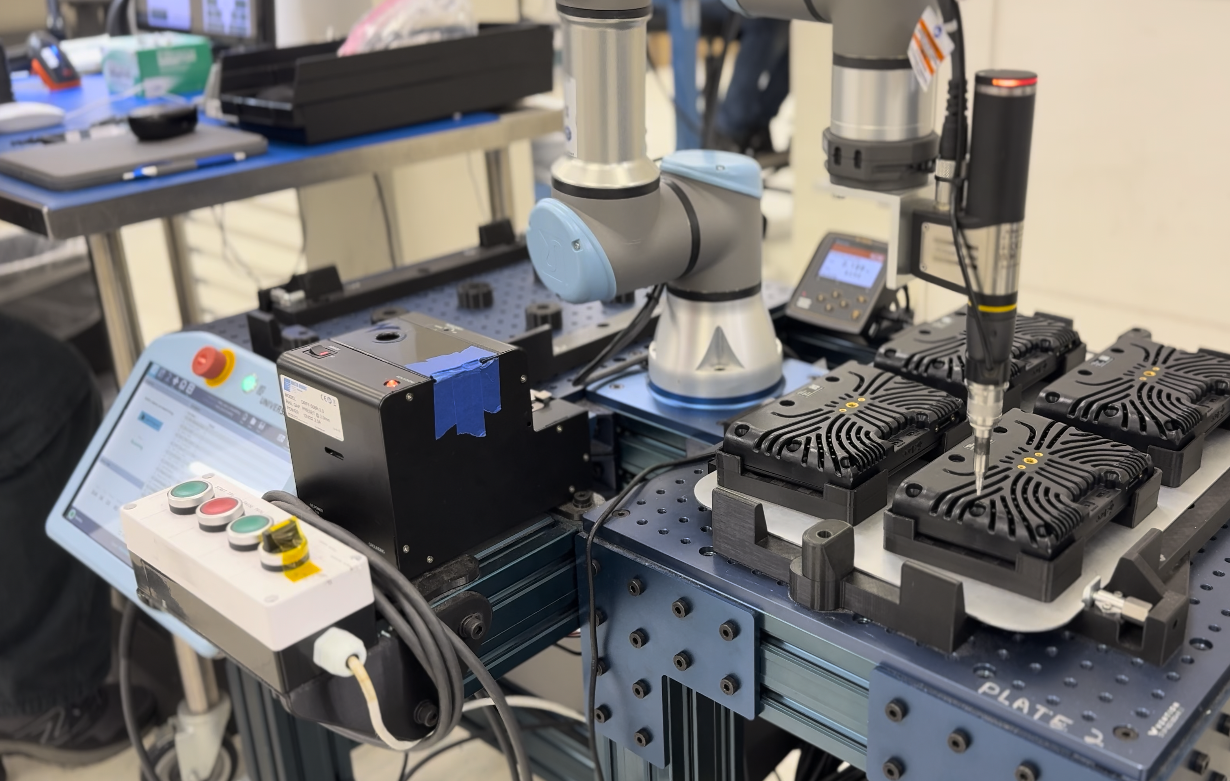
Our cobotic manufacturing work cells were programmed in-house using universal robotics hardware to perform tasks like placing and tightening fasteners, applying thermal paste, and building subassemblies. Automating steps like these allowed our production staff to focus on more difficult steps involving trickier components like floppy gaskets and flexible ribbon cables.
One of our favorite automation wins came from our set screw station. Set screws are tedious to check, and the typical ‘buddy’ system requires two people at the station – one to install and another to check and mark complete. This is an expensive yet necessary quality check that Hellbender was able to automate. Within 24 hours of identifying the problem, we built a real‑time computer vision quality gate that gave operators a thumbs‑up or thumbs‑down as each serial‑numbered unit passed underneath and was scanned for the set screw.
Instrumentation
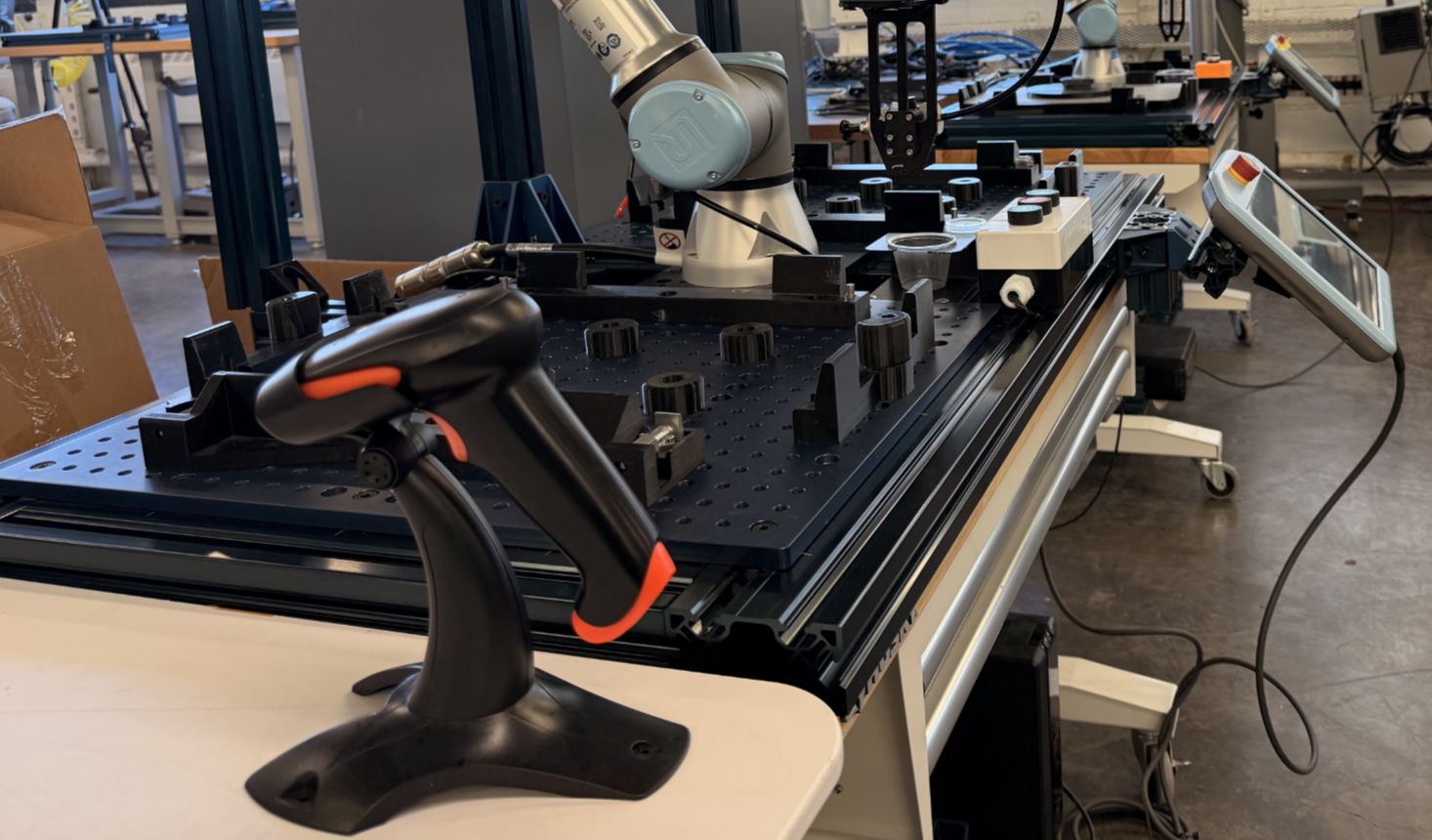
Instrumentation can be as simple as installing lightweight barcode scanners at each work station to capture real time throughput with minimal burden on operators. The moment a unit passes through a station, we’re able to log who did what work, how long it took, and any flags or quality holds. This made bottlenecks obvious and fixable.
For example, in early production, we quickly discovered a bottleneck at a specific station, despite no quality issues. Upon a quick discussion, we realized that ambiguous work instructions led that team member to do everything correctly, but in a less efficient way than necessary. We quickly fixed our work instruction, and removed the bottleneck, and throughput immediately recovered.
Instrumentation doesn’t just mean more visible throughput information though, it drastically improves traceability too. This is particularly helpful when managing multiple configurations of the same product. By linking our barcode scanners to our internal manufacturing database, we were able to capture and link everything from component level lot and serial numbers to which employee performed which work instruction on what date. The level of traceability our instrumentation enabled meant that any root cause analysis after production took minutes, not days.
A robotic arm programmed to insert screws at a consistent torque. Cobotic work cells execute tedious work and allow our production team to focus on more difficult and engaging tasks.
Each work station has a barcode scanner, just like you might see in a grocery store.
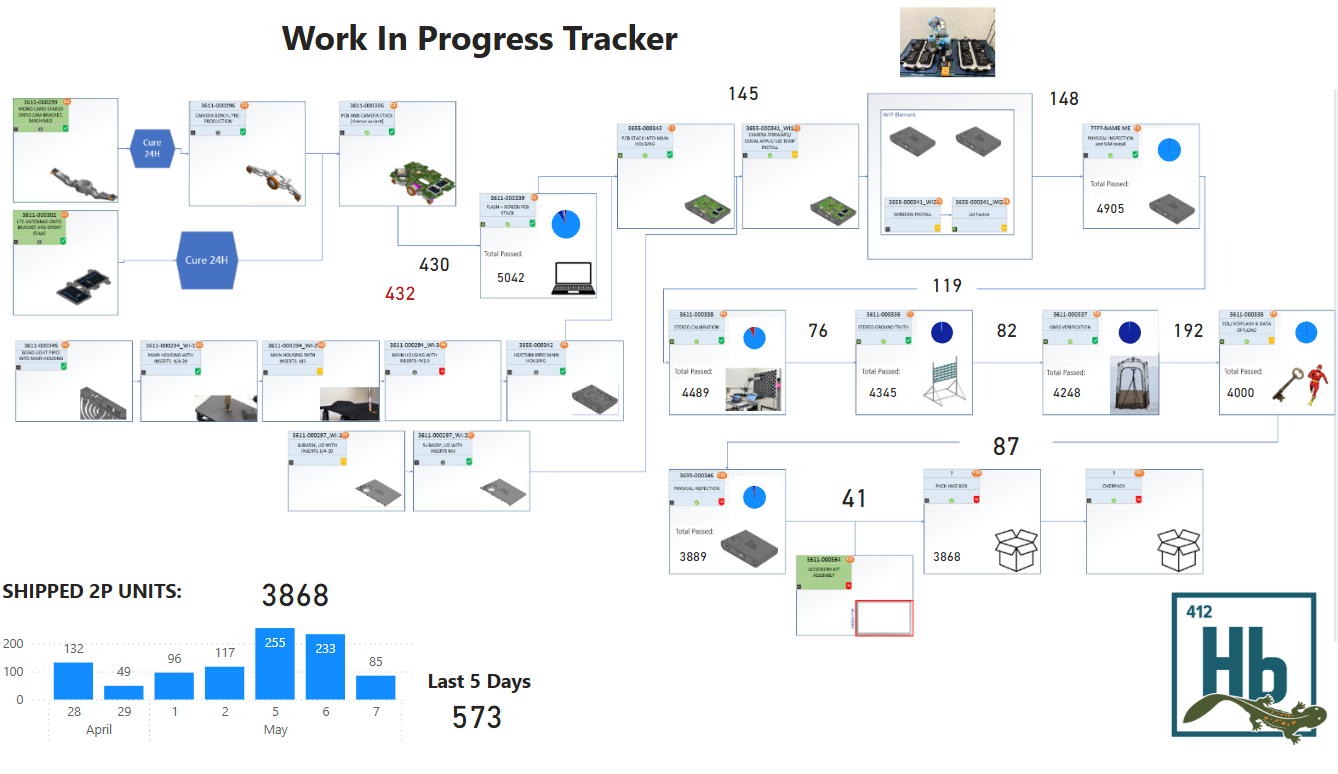
All the instrumentation feeds into a single flow chart, making it easy to identify bottlenecks as they occur.
Keeping American Manufacturing Competitive
This is how domestic manufacturing stays competitive: not through cheap labor or shortcuts, but through intelligent application of instrumentation and automation. By thoughtfully implementing cost saving technologies throughout the manufacturing process, we were able to decrease our cost of production by 70 percent. Those capabilities have only improved at Hellbender, and they’re how we continue to keep American manufacturing competitive for the next generation of on-edge perception systems.